
A starving rooster, a midnight horse race and a border that decided the shape of Chianti. Here is the legend behind the Gallo Nero seal, what Chianti actually tastes like, and the most beautiful wineries between Florence and Siena where you can pour a glass yourself.
A rooster, a midnight race and a border that never moved
If you pick up a bottle of Chianti Classico, you will find a small black rooster — the Gallo Nero — printed on the seal around its neck. It looks like a simple logo. In fact it is the survivor of a border war between two of the fiercest rivals of medieval Italy: Florence and Siena.
For centuries the two city-states fought over the hills of Chianti that lay between them. According to the legend that Tuscans still love to tell, they finally agreed to settle the border with a race. At the first cockcrow one morning, a knight would set out from each city, and wherever the two riders met would become the frontier.
Siena chose a plump white rooster and fed it well, sure it would wake bright and strong. Florence chose a black rooster and, cannily, half-starved it. The hungry bird was so agitated that it crowed long before dawn. The Florentine knight galloped off in the dark while the Sienese rider was still asleep — and the two met barely 12 kilometres from Siena, at Fonterutoli. Almost the whole of Chianti fell to Florence.

From a war emblem to a seal of quality
The black rooster was adopted as the emblem of the Lega del Chianti, the medieval military league of the Chianti townships, and it has watched over these hills ever since. In 1924 a group of producers put it on their labels as the badge of the Consorzio Vino Chianti Classico, and today it is a legal guarantee: since 2005 every bottle of Chianti Classico DOCG wears the Gallo Nero, certifying that the wine was grown and made inside the historic zone between Florence and Siena.
This is where most people get confused, so it is worth being clear. "Chianti" is a large denomination that stretches across much of Tuscany. "Chianti Classico" is the small, original heartland — the hills where the story began — and it is the only one entitled to the black rooster. If the neck of the bottle shows the Gallo Nero, you are holding wine from the classic zone.

What is actually in the glass
Chianti is a dry red wine, and its soul is a single grape: Sangiovese. In Chianti Classico the blend must be at least 80% Sangiovese, and many of the best estates go all the way to 90–100%. White grapes, once common in the blend, have been banned in Chianti Classico since 2006. The wine has been a DOCG — Italy's highest quality tier — since 1984.
In the glass it is a bright ruby, rarely deep or inky. Expect aromas of sour cherry and red plum, violets, dried herbs and a savoury, earthy note of leather or tobacco as it ages. What makes Chianti unmistakable is its structure: fresh, mouth-watering acidity and firm, gripping tannins. That is exactly why it is one of the great food wines — it comes alive with tomato-based pasta, ragù, grilled meats, a Florentine T-bone steak, or a wedge of aged pecorino.

Annata, Riserva, Gran Selezione — and the old straw flask
Chianti Classico comes in three tiers, and it helps to know them before a tasting. Annata is the classic, youthful style, released after about 12 months. Riserva is aged at least 24 months and is deeper and more structured. Gran Selezione, introduced in 2014, sits at the top: made only from a single estate's own grapes and aged at least 30 months, it is the flagship of the zone.
You may remember Chianti in a round bottle wrapped in a straw basket — the fiasco. It was a practical piece of craftsmanship that protected the glass, but it also became shorthand for cheap trattoria wine. Serious Chianti now comes in a standard Bordeaux bottle; the fiasco survives mostly as a charming souvenir and a candle holder.

Castello di Brolio: where modern Chianti was born
If you visit one estate, make it Brolio. The Ricasoli family has made wine here since 1141, which makes Barone Ricasoli the oldest winery in Italy and one of the oldest in the world. In 1872 Baron Bettino Ricasoli — the "Iron Baron" and the second prime minister of a newly united Italy — wrote down the recipe that put Sangiovese at the centre of Chianti, essentially inventing the wine as we know it.
The castle sits on a ridge above Gaiole in Chianti with sweeping views over the vineyards. You can walk the ramparts and formal gardens, visit the cellars, and taste the wines on a panoramic terrace. It is history and a glass in one stop.

Castles, art and Renaissance villas to taste in
Chianti makes it easy to combine wine with a castle, a work of art or a slice of Renaissance history. A few favourites, all of which welcome visitors for tastings — book ahead, as most work by appointment:
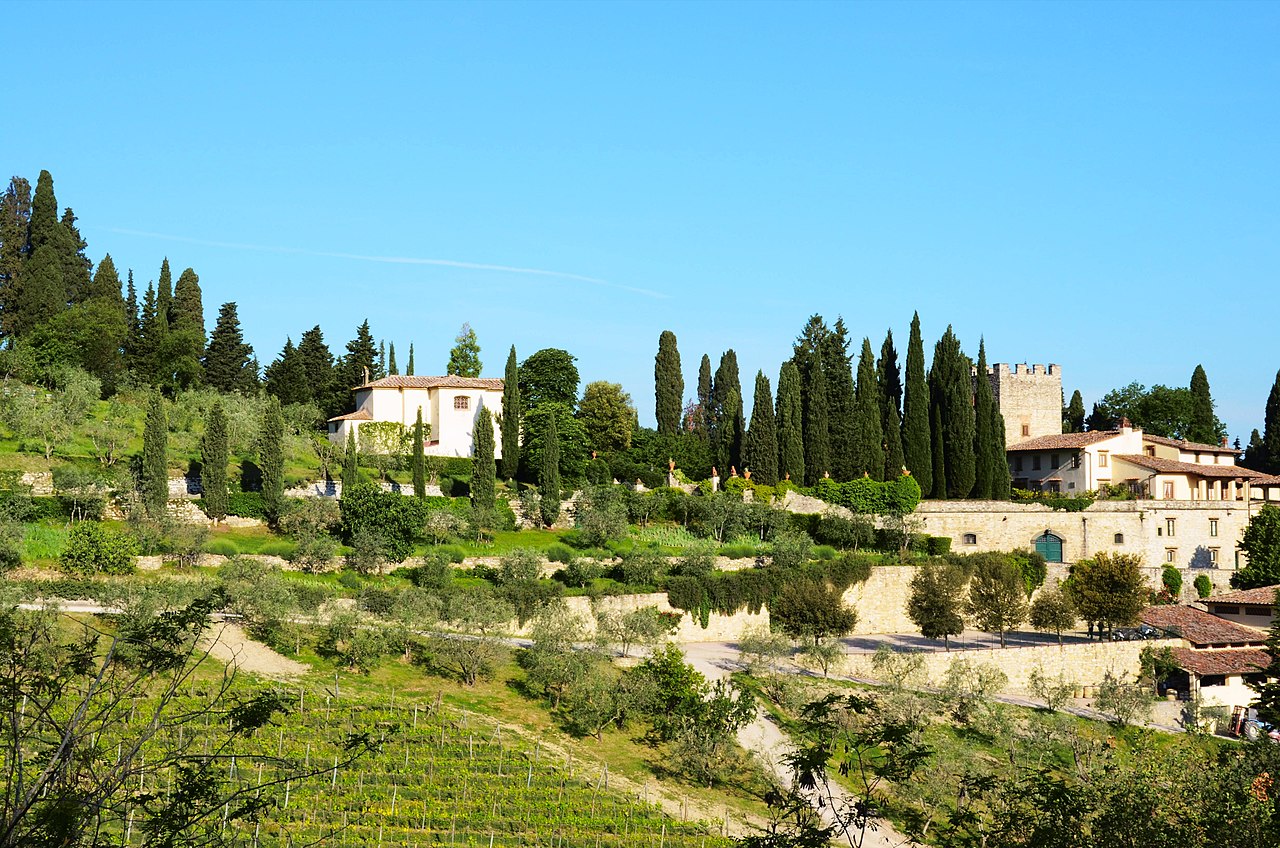
Castello di Verrazzano, above Greve, was the birthplace of Giovanni da Verrazzano, the navigator who first sailed into New York harbour and gave his name to its bridge. Castello di Ama, near Gaiole, pours excellent wine among an astonishing collection of contemporary art scattered through the estate. Castello di Fonterutoli, run by the Mazzei family since 1435, sits close to the very spot where the legendary race is said to have ended. Villa Vignamaggio, a golden Renaissance villa near Greve, is linked to the woman believed to have modelled for the Mona Lisa and starred as a film set for "Much Ado About Nothing". And the Antinori nel Chianti Classico winery near San Casciano is a piece of modern architecture in its own right — a cellar built into the hillside beneath a terraced roof of vines.
Just south of Chianti: Vino Nobile di Montepulciano
If Chianti gives you a taste for Tuscan Sangiovese, keep heading south. Around the golden Renaissance hilltown of Montepulciano the same grape — here called Prugnolo Gentile — makes Vino Nobile di Montepulciano, one of Italy's oldest "noble" wines and a DOCG since 1980. It tends to be fuller and more powerful than Chianti, with the same bright cherry fruit and firm backbone.
One thing to clear up, because it trips almost everyone: this is the Tuscan town and its Sangiovese wine, not Montepulciano d'Abruzzo, which is a completely different grape from another region. The town alone is worth the drive — a ridge of honey-coloured palazzi, cavernous cellars dug beneath the streets, and long views over the Val d'Orcia. Pair it with nearby Montalcino, home of the mighty Brunello, and you have a grand tour of Tuscany's greatest reds.

Planning a Chianti wine trip
The Chianti Classico zone lies right between Florence and Siena, and either city makes a fine base — or stay in the heart of it in a village like Greve, Radda, Castellina or Gaiole. The classic route is the SR222, the Chiantigiana, a winding ridge road that strings the wine towns together through cypress and vineyard.
A few practical notes. You will want a car to reach the estates, but tastings mean wine, so plan a designated driver, hire one, or join a small-group tour. Book cellar visits in advance — most estates require it. The best months are September and October, when the harvest is in full swing, or the soft, green weeks of May and June. And leave time simply to sit on a terrace with a glass and the view; that, in the end, is the whole point of Chianti.